
Inside the World of The Time Traveling Scoreboard

The world of The Time Traveling Scoreboard is built on a precise and unusual mechanism: time travel is not tied to the stadium as a whole, but to a specific structure, the manual scoreboard at Wrigley Field. The scoreboard functions as a controlled viewing portal, where access to the past is only possible through physical “windows” within its framework. These openings do not transport the body fully through time, but instead allow the observer to witness, and in limited cases interact with, historical moments occurring within the ballpark
The Trigger: A Missing Scoreboard Piece in the Ivy
The story begins during a modern-day Wrigley Field tour when Ace Preston, a retired law enforcement officer and U.S. Army Reserve veteran, discovers a weathered metal scoreboard number hidden in the ivy along the outfield wall. The object matches the dimensions and design of a piece used in the stadium’s manual scoreboard system.
This discovery is not random; it acts as the key that draws Ace toward the scoreboard structure itself. Without returning the piece, the mechanism would remain dormant. By choosing to restore it, Ace unknowingly activates access to the scoreboard’s interior world.
Entry Into the Scoreboard Structure
Ace follows the physical access point beneath the scoreboard and enters through a maintenance door and ladder system into the internal framework. Inside, he meets Ron, a scoreboard operator who works within this structure as part of its ongoing manual operation.
Ron is not a guide in a mystical sense, but a functional operator tied to the scoreboard system itself. He manages scoreboard panels, manually adjusts game information, and controls the “viewing windows” that open onto different historical moments tied to the stadium’s layered past.
The First Time Window: 1915 Federal League Baseball
The first activated window places Ace into June 25, 1915, during a Chicago Whales (Federal League) game at Wrigley Field’s historical predecessor configuration. Through a removed scoreboard panel, Ace does not physically travel to 1915 in a traditional sense, instead, he is positioned in a viewing and partial-access point where the past is fully visible and experientially immersive.
From this vantage, Ace:
- Observes authentic-era uniforms and crowd behavior
- Experiences the stadium as it existed without modern modifications
- Interacts within limited boundaries (such as seating transitions and short encounters)
His actions remain constrained by the scoreboard’s structural “window” limitations.
The Currency Clue and Mission Thread
During this time-window interaction, Ace receives a 1915-era currency note containing a written message:
“Find the tire man, Ace; prevent his financial ruin…”
This message establishes a secondary narrative thread. It is not random fortune, it functions as a directive embedded within the scoreboard’s timeline system. The implication is that the scoreboard does not merely observe history; it selectively reveals moments requiring intervention.
Mechanism Rules: What the Scoreboard Actually Does
Inside the story’s logic, the scoreboard operates under three consistent rules:
- Windowed Access, Not Full Time Travel
Ace does not permanently relocate to another era; he observes and briefly participates through controlled openings. - Location Anchoring
Every temporal experience is tied to stadium history (Wrigley Field and later Fenway-linked transitions), not arbitrary global time travel. - Limited Interaction Boundaries
While Ace can speak, move within restricted zones, and influence minor outcomes, the system prevents full historical alteration on a large scale.
Expansion Beyond Chicago: Fenway Temporal Shift
The mechanism later expands when Ace experiences a transition from Wrigley Field into a Boston Fenway-linked environment. This shift is not geographic travel but another scoreboard window alignment, placing him within a different historical stadium context.
Here, he enters a layered timeline including:
- A 1975 Boston Red Sox game environment
- Real-world historical players such as Carlton Fisk
- A parallel narrative involving mascot Wally the Green Monster uncovering a hidden criminal scheme tied to baseball memorabilia
This confirms that the scoreboard can access multiple historical “nodes,” not just a single era.
Core Theme of the World
At its foundation, the scoreboard world is not about changing history freely. It is about selective observation, constrained participation, and moral decision-making within fixed historical frames.
Ace Preston’s journey is defined by how he responds to what the scoreboard reveals, not by controlling time itself, but by navigating responsibility within it.
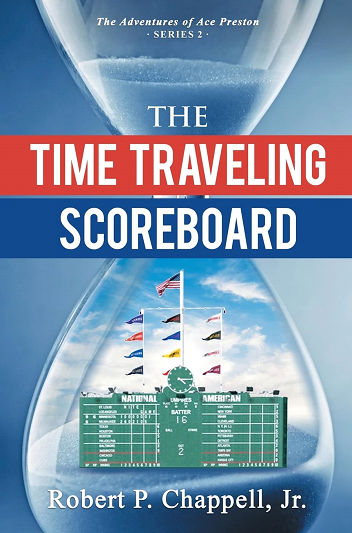
Step Into the Adventure
Inside the world of The Time Traveling Scoreboard by Robert P. Chappell, Jr., every inning holds possibilities, every stadium hides secrets, and every choice echoes through history. It is a story of discovery, nostalgia, and the search for meaning when life enters a new chapter.
If you enjoy baseball, time travel, and stories where ordinary places become extraordinary, this journey is waiting for you.
Ready to step inside the scoreboard?
Discover the full adventure and follow Ace Preston as he travels through baseball history, hidden mysteries, and unforgettable moments that blur the line between past and present. Get your copy today!